EDU604_30_Diversity Issues in 21st Century Education_2022_23_TERM6
Investigation Paper
Andrew Parrella
Post University
Dr. Virginia Metaxas
Andrew Parrella
Master of Education – Post University
Education 604 Diversity Issues in 21st Century Education
Dr. Virginia Metaxas
Issue Investigation
Introduction and Thesis Statement
The importance of understanding culture and diversity in our 21st century learning environments is crucial as an increasingly diverse population is entering our school system. Key points that are affecting these trends are diverse cultural populations that are in the United States that have continued since the last century. Noteworthy, is a trend to increase in English Language Learners (ELLS) who have entered our school systems in many states. Larger states including California, Texas, and Florida as well as Connecticut and others have seen large populations of Latinos and other non-English speaking populations. The practice of former teaching models and methods, that may not be able to meet the needs of these populations becomes complicated if we use older methods of non-inclusiveness – where people’s cultures had to be quickly assimilated by communicating in a native country tongue- English in the United States – and expecting that those who are not proficient in this be able to learn effectively. This concept of cultural difference – especially in language – is something that is factual in numbers through increased populations around the country. This issue or ELL’s need to have an incredibly supportive structured curriculum with teachers, school systems and systematic tools in place to help support curriculum that helps level equality. This paper will highlight some of these points.
Rationale and Importance
Statistically, it is important that educators be challenged to develop the ability to have cultural awareness and be able to bring pedagogy that supports understanding from traditionally predominantly White teacher educators from preschool up to grades twelve. Bohan (2020). When teachers are trained for example, the experiences that stress a deeper look into the teacher’s own experiences through analysis of, “..autobiographical explorations, literature circles, critical reflection, and dialogue…” (Roberts, 2020 as cited in Bohan, 2020, p. 217), indicate that is in proper training of teachers that the beginning of viewpoints, thoughts, preconceived notions or beliefs can start even before the issue of language starts. However, language is the key communication method often first judged in many educator’s expectations of what comes out through that language and what a child knows or understands. This first challenge is a large hurdle and can be said to be a “monocultural perspective” (Roberts, 2020 as cited in Bohan, 2020, p. 217). We must therefore deconstruct what we knew or thought we knew to be the only way to look at a cultural influence and its ability to control our learning environment. We must institute, “culturally responsive teaching” method (Roberts, 2020 as cited in Bohan, 2020, p. 218).
Statistically, it is “women who represent 77% of the teacher population and 80% of teachers are White” (Loewus, 2017 as cited in Bohan, 2020, p. 218). Demographics have change dramatically as the trends of Black, Hispanic, and Asian students are surpassing Whites in the United States (Loewus, 2017, as cited in Bohan, 2020, p. 218). In a data analysis, (Bohan, 2020) found five emerging findings of significance. Her study and example of paying for a county meal and putting money on the table rather than handing it to the Black cashier had offended the cashier. The problem is twofold, the first being the prejudgment of the Black cashier of judging the white guest for just putting money on a table and the second was the judgment by the White guest that the Black cashier was judging her for her action of placing money on the table. One could see that it would depend on the preconceive notions of cultural differences on how to transact business. Significant and relevant to teaching and learning was this example as these were educators learning outside the classroom about preconceived cultural differences (not even language ones) but non-verbal.
The greater concept of social change and acceptance for how a controlling group of cultural White dominating baseline of how society is operating, is chilling because it says a lot about how we not only think, but unconsciously act towards different people, even before we speak! A Framework in these studies revealed the necessity of directly addressing the issues of why we function as we do. In this case, the framework included: “White identity theory, (understanding one’s own thinking), (Howard, 2006 as cited in as cited in Bohan, 2020, p. 221); Critical literacy theory, (dominant society members exerting their own voices unknowingly and knowingly by silencing the other), (Freire and Macedo 1987 as cited in Bohan, 2020, p. 221), Cultural relevant pedagogy (including voices of the traditionally silenced or oppressed),
(Ladson-Billings, 1994 as cited in Bohan, 2020, p. 221).
The findings in the training of these educators after implementing an inquiry of conditional themes and behaviors clearly showed some revealing things. Race as a subject of discussion was found to be a taboo to discuss. This was a supporting theory of McIntyre (1997), or “white talk” (p. 45) (as cited in Bohan, 2020, p. 228). Another finding significant which showed a bias in teachers and teaching curriculums was inaccurate and hence needed changes were desired in the consideration of multiple perspectives and “critically evaluating teaching materials” (as cited in Bohan, 2020, p. 228).
This is significant as it shows two things. First, that current challenges to methods of teaching through a process of unlearning what teachers have learned is necessary and that the willingness to open methods of change can take place and is necessary. This would clearly be supporting evidence that English Language Learners would be a next step in the process.
History again dominates our understanding of a culture build on colonialism and White supremacy as colonial settlement, now called the United States. Gerald, J. (2022). In the analysis of how we got to our modern-day preeminence of English, especially the language but even more readily the language spoken or native tongue of ruling people (Named White), the author examines the pattern and cultural development of a “racial capitalism” (Gerald, 2022, p. 7), which expanded and continued into a social ideology of “exploitation” (Gerald, 2022, p. 7). This underlying historical model is a good example to understand how pervasive in indoctrinated our society is today from past centuries and is continuing. In order to fully understand something as seemingly simple as English Language Learners or ELL in the school systems, we have to deconstruct the historically ingrained and interwoven nature of capitalistic society accepted and developed normed and their influence over people, power, and the delivery of services all the way down to how our educational system is being delivered. It is a daunting task.
“Language ideologies descend from broadly shared societal views about languages and languagers and shape communication and standardization in a given context” (Ricento, 2013 as cited in Gerald, 2022, p. 7). Significant in the that these language ideologies create the parameters of what we would identify as “standard” or accepted language rather than another language (Gerald, 2022, p. 7). Because anyone, especially younger students in the process of learning would be viewed as deficient, the standard used is often defective and hence the needed changes for the instruction of ELL learners in our curriculum. It is noted that scholars have proposed the concept of “translanguaging” (Gerald, 2022, p. 7), to classify minority language learners. Exclusionary references to the oppression of viewing ELL learners as people who may be separate similar at the word “dis/ability” (Gerald, 2022, p. 7) as the author so specifically denotes in writing with a separate slash to compare how our society and culture is build on separation or exclusiveness. This is another key concept in the ability of education curriculum to change and grow and be inclusive especially with ELLs. The societal reference or “pathology” (Gerald, 2022, p. 7) is the sad and damaging social process that categorizes individuals and groups as inferior and needing treatment by the those in power. Some did this to have power and others to identify what was taking place for a quick fix of a societal situation.
In a very poignant report included in the analysis of the embedded thought process of institutionalized and accepted ability of people to learn is in this US Department of Education (2015) report:
An individual ages 3–21 who is enrolled or preparing to enroll in an elementary school or secondary school; who was not born in the United States or whose first language is a language other than English, who is a Native American or Alaska Native or a native resident of the outlying areas and comes from an environment where a language other than English has had a significant impact on his or her level of English language proficiency, or who is migratory, has a first language other than English, and comes from an environment where a language other than English is dominant; and whose difficulties in speaking, reading, writing, or understanding the English language may be sufficient to deny him or her the ability to meet the proficient level of achievement on state assessments, the ability to successfully achieve in classrooms where the language of instruction is English, or the opportunity to participate fully in society. (US Department of Education, 2015: 3) (Gerald, 2022, p. 45).
This perceived “deficit mindset.” (Gerald, 2022, p. 45), is shows we must have the will to change our methods in curriculum. The concept of “raciolinguistic ideologies” (Flores & Rosa, 2015; Rosa, 2018; Rosa & Flores, 2017 as cited in Gerald, 2022, p. 49), is a great example of a method that the author promotes not only acknowledgement of this concept but goes even further to stress the impact of the these developed language users as being set up for failure as they must conform to an exact standard. Even the term ELL although is a label of assumption just as ESL is as we do not know that just because someone does not speak English as a first language perfectly, that it is their “second language” or that they are only in the learning phases. They may have other disabilities which we would have to decipher. The term that is preferred by this author is, “translanguaging,” or “multilingual learners,” as a preferred acronym (Gerald, 2022, p. 45).
Multicultural education must strive to meet the seven strategic Propositions from research and practice. These must include a leadership style that combines passion with competence with demonstrated expertise among people in key positions and continuous improvement that will have clear and effective instruction. For instructional improvement to take place, this instruction should be streamlined and be understandable with materials that can develop and support the delivery of the curriculum. For ELL’s especially, after the recognition of the underlying challenges of the need are accepted, then a streamlined and coherent curriculum can be developed. The Achievement Gap Initiative at Harvard University (2008).
In an out-of-the box thinking about cultural influences on learning,(Ladson-Billings, 2006, p.106), describes the influence or limited thinking that all problems with learning and teacher response is related specifically to culture itself but rather to what she terms, “self-esteem” issues and our fault of continued comparison to other societies, other economic powers, other cultures and not intrinsic in the individual difference or self-worth. This is a novel but overlooked concept because as humans we want to be collective and sometimes try to take away looking at something from another viewpoint. The term culture can sometimes be a challenge to answer or categorize things in learning as well. An example here would be: why are the students talking loudly? Is it because they are black or something else? This would be an assumed cultural solution or answer. This can be equally dangerous as of not recognizing the culture aspect of the why someone is not learning. The range of factors contrasts to just a simple explanation of it is a cultural difference and can mask other issues such as economic ones for example. In the studies, (Ladson-Billings, 2006) found very revealing prejudgments by teachers in training on how they preconceived the results of experiences of why a parent of a minority could not attend a meeting, and these were cultural not real issues such as money for one student’s parent who may be working two jobs, or perhaps one student came from a one parent family or foster home. The theme or suggested changes were to normalize or give teachers exposure to real-life situations where they could see each student individually as for what they were experiencing not only culturally but as a particular situation. The same idea is relevant to ELLs in that their expression is in direct connection to what they are also experiencing individually perhaps with cultural influences but not necessarily only cultural influences.
In California for example, students identified as ELLs have performance studies which indicate that in those registered in Charter schools had a fraction of outperformance of “25% in reading and $29% in math” (Rapa, Katsiyannis, and Ennis, 2018 p.3133). The performance of some Charter schools was worse at, “19% in reading and 31% in mathematics” than in traditional schools. This indicates some fluctuation in the type of education and its affect on learning possibly because but not exclusively because of cultural influences and/or other factors. Noteworthy, was an increase from years 2009 to 2013 where gains were seen in reading and math for, “Hispanic, Black, and English learners as well as those with disabilities in reading” (Rapa, Katsiyannis, and Ennis, 2018 p. 3133).
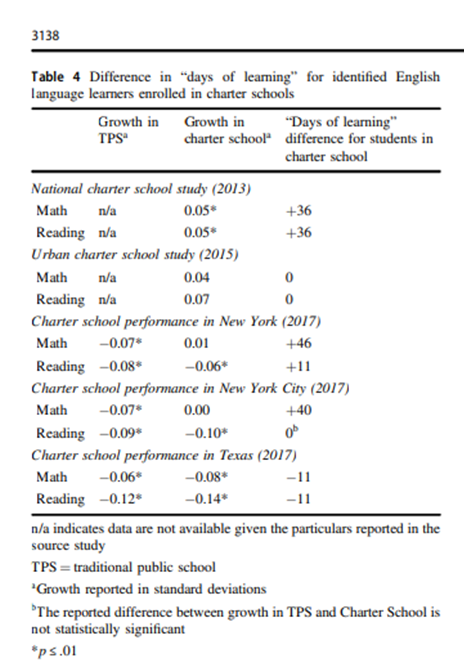
Because of discrepancies in the data for Charter vs. Traditional schools, further studies of data in other schools in New York by (CREDO study in 2009) and (Cremata et al. 2013 as cited in (Rapa, Katsiyannis, and Ennis, 2018 p.3135), of 27 states showed that 95% comprised schools in charter school districts with 54% of students in poverty, 8% disabled, 9% ELLs, and ethnic-racial breakdown of 35% White, 29% Black, 28%Hispanic, 3% Asian/Pacific Islander, and 4% Other, from 2006-2007. This study concluded that 8 of 10 regions that reported a higher percentage of students with ELLs in the traditional public-school setting vs. the charter school setting, had a 5%-point difference noting higher levels of ELLs in traditional public-school settings. Therefore, the growth in both math and reading was valid due to the type of school placement. Incredibly significant even though small percentages were observed. “Math growth was even more substantial for students enrolled in a charter school as compared to their traditional public-school peers, with charter schools’ students experiencing 40 additional days of learning” (Rapa, Katsiyannis, and Ennis, 2018 p. 3133).
A Chart of Difference in days of learning for students ELLs can be found in Appendix 1 for more statistical analysis of ELLs. This shows that although ELLs students in traditional and charter school settings underperformed their peer show er not in ELLs settings, they did have more academic growth compared to their ELL peers enrolled in traditional public schools.
The effects of culture, especially the ELLs in this case are affected through their environmental setting and this will affect their overall lifespan. The democratic trend of increased numbers of ELLs and the issues of multiculturalism, including gender, achievement gaps, and a global impact on the workforce and its development and ready preparedness will be impacted if these changes are not implemented as quickly as possible. In addition, the stereotype that has developed in the attitude of the public that people who are linguistically deficient is a matter of judgment. As a program of research of working-class and middle-class children encountering oral storytelling shows that a personal perspective on those especially from a lower economic factor such termed working-class there was a positive approach towards a child’s development skills when they narrated experiences of self-dramatizing in language, although the acceptance of that view was not necessary always present. Miller, P.J., Cho, G.E., & Bracy, J. R (2005). These two factors of familial cultural upbringing, and the societal expectation of oral storytelling indicate that acceptance and a person’s rights can be influenced by culture -this would be even more complicated for ELLs due to possible multiple combinations associated with the language barrier.
Another example we can connect a strategy for learning that would be a positive way to help accommodate all learners, including ELLs would be visual language and visual literacy skills. Through visual arts curriculum we can use scaffolding through art (Smilan, 2017). This also helps socially by including the facilitation of a community of belonging for children who have a different native tongue. Because the present culture of a school could be strongly encouraging an assimilation to a nationally or unofficially language standard, one way is to include or develop curriculum which can help with “self-efficacy and inclusiveness” Smilan, C. (2017, p.1).
The best question that can be answered to bridge the gap that ELLs may face is for policies and developers of curriculum to have an “inclusive socioeconomic agenda” Smilan, C. (2017, p.1), which can support the inclusion of “cultural capital” necessary for better achievement tools. Reflective practice and truly acknowledging the deficits we face is crucial for support of differentiation in curricula that will work. “Disconnect between the backgrounds of students and the teachers who teach them” has been identified by Ball (2009) (as cited in Smilan, C. (2017), and in order to the need to develop “teacher identities that include content and pedagogical knowledge as well as deep cultural knowledge of the students they will teach” Smilan, C. (2017). The need for continued “conscious inward reflection on how teacher attitude may be influenced ‘by unacknowledged cultural privileges and family imprinting’ (Broome, 2014, p. 182” (as cited in Smilan, C. (2017), is necessary.
In an achievement gap initiative (The Achievement Gap Initiative at Harvard University, 2008), one strategy that of seven that breaks down students by grade level, special education status, English as a second language, status, race/ethnicity, and gender, the goal is for “data-driven decision making and transparency” (The Achievement Gap Initiative at Harvard University, 2008). This shows that although all the multitude of factors from leadership, instruction that is effective, streamlined approach, organized structures and personnel, accountability and community involvement and resources, that data-driven facts will be a driving force to move the process of addressing the gaps that ELLs face as the numbers do not lie.
We would not be inclusive to the learning process if we did not note the impact that peer learning can also play on English Language Learners. ELLs who have engagement in complex speech during peer interactions have been positive however with some limitations due to variables of partners. (Washington-Nortey, P.-M., Xhang, F., Xu, Y., Ruiz, A.B., Chen. C.C., & Spence, C., 2022). It is noted that especially in the preschool settings, the early year language competency developments are significant and the social skills and “parent-child interactions, socio-economic status, resource availability, teacher-child interactions, and classroom quality have been associated with the development of earl language competencies (Pace et al. 2017; Pasconfar and Vernon-Feagans 2006 as cited in Washington-Nortey, P.-M., Xhang, F., Xu, Y., Ruiz, A.B., Chen. C.C., & Spence, C. (2022).
Conclusion
In conclusion, study after study is revealing that a range of factors influenced by culture, economic, ethnicity, race, gender, political policies, teacher beliefs and training, student experiences, peer influences, societal accepted norms, historically learned education (correct or incorrect), and further breakdowns of combinations of all of these can produce a culture of learning that has and is demanding change and improvement. Many school districts are implementing various programs and initiatives, but the support, data and community drive must continue so the curriculum that is developed reflects the best possible learning environment for the students.
References
Miller, P.J., Cho, G.E., & Bracy, J. R (2005). Working-Class Children’s Experience through the Prism of Personal Storytelling. Human Development, 48(3), 115-135. http://dx.doi.org.postu.idm.oclc.org/10.1159/000085515
Rapa, L.J., Katsiyannis, A., Ennis, R.P. (2018, June 17). Charter School Enrollment Effects: A Review of Results from Recent Large-Scale Studies. Journal of Child & Family Studies. 2018:27(10): 3132-3140.doi:10.1007/s10826-018-1143-z
Smilan, C. (2017). Visual immersion for cultural understanding and multimodal literacy. Arts Education Policy Review, 118(4). 220-227. https://doi-org.postu.idm.oclc.org/10.1080/10632913.2017.1287805
The Achievement Gap Initiative at Harvard University (2008). Raising Achievement and Closing Gaps in Whole School Systems: Recent Advances in Research and Practice
Washington-Nortey, P.-M., Xhang, F., Xu, Y., Ruiz, A.B., Chen. C.C., & Spence, C. (2022). The Impact of Peer interaction on Language Development Among Preschool English Language Learners: A Systematic Review. Early Childhood Education Journal 50(1), 49-59. https://doi-org.postu.idm.oclc.org/10.1007/s10643-020-01126-5
Reference Appendix
(Appendix 1)
Overview of Investigation
This was an informative and enlightening exercise in the discovery of how far-reaching the effects of cultural differences can have on learners, expecially the English Language Learners ELLs. Not only are the methods of past trained teachers in need of assessment but so many other curriculum connections that will enhance the student’s environment to be more inclusive, non-judgmental, innovative in thinking and practice as well as delivery are paramount for the future of learning and the long-term goal of effective learning for life in a greater social context.
Andrew Parrella
Memory, Memoire, and Mastery Presentation on The Skin That We Speak by Andrew Parrella EDU_604 Diversity Issues in 21st Century Education Term
Reflections on The Skin That We Speak
Reading The Skin That We Speak brought about the issues that differences in language and linguistic difference can bring for those who may be exposed to a different culture, language or system of government then they are presently being educated and living in. The various struggles of peer pressure, discrimination, bullying, non-acceptance, challenges on cognitive ability due to language barriers and typical society norms of that time period or of a nation who may identify from traditional colonialism, and non-tolerance of differences of those who may learn differently, is far-reaching and shows the need for changes in the curriculum styles, education of educators, education of various societal culturally accepted norms or traditions, that may control, inhibited or endanger those who may be struggling with these issues. Language is a very many splendored thing and we should cherish it, incorporate different forms of it and cultivate and celebrate the differences rather then destroy it!
La langue est une chose très splendissante et nous devrions la chérir, en incorporer différentes formes et cultiver et célébrer les différences plutôt que de la détruire!
Il linguaggio è una cosa molto raffinata e dovremmo amarla, incorporarne diverse forme e coltivare e celebrare le differenze piuttosto che distruggerla!
Is rud an-spleodrach í an teanga agus ba chóir dúinn í a chothú, cineálacha éagsúla di a ionchorprú agus na difríochtaí a chothú agus a cheiliúradh in áit í a scriosadh!
Sprache ist eine sehr vielgestaltige Sache, und wir sollten sie schätzen, verschiedene Formen davon einbeziehen und die Unterschiede kultivieren und feiern, anstatt sie zu zerstören!
اللغة شيء رائع للغاية ويجب أن نعتز به وندمج أشكالا مختلفة منه ونزرع الاختلافات ونحتفل بها بدلا من تدميرها! legha shaya raea leghaya wijp an notz beh wendemge ashkala makhtalfa minneh vanzara alakhtlafat wanhatfale baha budla minn tedmirha!
語言是一件非常多的燦爛的東西,我們應該珍惜它,融入它的不同形式,培養和慶祝差異,而不是破壞它!yǔyán shìyījiàn fēichángduōde cànlàn de dōngxī , wǒmen yīnggāi zhēnxī tā , róngrù tāde bùtóng xíngshì , péi yǎnghé qìngzhù chāyì ,érbùshìpòhuàitā!
La langue est une chose très splendeur et nous devrions la chérir, en incorporer différentes formes et cultiver et célébrer les différences plutôt que de la détruire!
¡El lenguaje es una cosa muy esplendorosa y debemos apreciarlo, incorporar diferentes formas de él y cultivar y celebrar las diferencias en lugar de destruirlo!
Język jest rzeczą bardzo wspaniałą i powinniśmy go pielęgnować, włączać różne jego formy oraz kultywować i celebrować różnice, a nie go niszczyć!
言語は非常に多くの素晴らしいものであり、私たちはそれを大切にし、さまざまな形を取り入れ、違いを破壊するのではなく、違いを育み、祝うべきです! gengo wa hijou ni ooku no subarashii mono de ari 、 watashi tachi wa sore wa taisetsu ni shi 、 samazama nani kei wa toriire 、 chigai wa hakai suru no de wa naku 、 chigai wa hagukumi 、 iwau beki desu !
Η γλώσσα είναι ένα πολύ λαμπρό πράγμα και πρέπει να την αγαπάμε, να ενσωματώνουμε διαφορετικές μορφές της και να καλλιεργούμε και να γιορτάζουμε τις διαφορές αντί να την καταστρέφουμε! iii glossa einai ein poly lampros prague kai prepei nha then agapame, nha encompass diferite morfes ths kai nha kaliergoume kai nha giortazoume these divergent and nha then catastroifume!
שפה היא דבר מפואר מאוד ועלינו להוקיר אותה, לשלב צורות שונות שלה ולטפח ולחגוג את ההבדלים במקום להרוס אותה! shfe haya deber mepuar much valeno lockir otha, leshlev tzorot shonot shla waltfach valhagog at acadelim bimkom lahros otha!
Il-lingwa hija ħaġa mill-isbaħ ħafna u għandna ngħożżuha, ninkorporaw forom differenti tagħha u nikkultivaw u niċċelebraw id-differenzi pjuttost imbagħad neqirduha!
Bahasa adalah hal yang sangat megah dan kita harus menghargainya, menggabungkan berbagai bentuknya dan mengolah serta merayakan perbedaan daripada menghancurkannya!
Tungumál er mjög mikill prýðilegur hlutur og við ættum að þykja vænt um það, fella inn mismunandi form þess og rækta og fagna muninum frekar en eyðileggja það!
Dil çok ihtişamlı bir şeydir ve onu el üstünde tutmalı, farklı formlarını birleştirmeli ve onu yok etmek yerine farklılıkları geliştirmeli ve kutlamalıyız!
भाषा एक बहुत ही आकर्षक चीज है और हमें इसे संजोना चाहिए, इसके विभिन्न रूपों को शामिल करना चाहिए और इसे नष्ट करने के बजाय मतभेदों को विकसित करना और जश्न मनाना चाहिए! bhasha ek bahut hi akarshak cheez hai aur hamein ise sanjona chahiye, isake vibhinn rupon ko shamil karna chahiye aur ise nasht karane ke bajay matbhedon ko viksit karna aur jashn manana chahiye!
Ulimi luyinto eningi kakhulu ehlonishwayo futhi kufanele siyithande, sifake izinhlobo ezahlukene ngalo futhi sihlakulele futhi sigubhe umehluko kunalokho bese siwubhubhisa!
Taal is ‘n baie prag ding en ons moet dit koester, verskillende vorme daarvan inkorporeer en die verskille kweek en vier eerder as om dit te vernietig!
Мова – це дуже чудова річ, і ми повинні плекати її, включати різні її форми, культивувати та святкувати відмінності, а не руйнувати її! mova – tse dougé chudova rich, i mee povinny plecate ye, vkljucati rizney ye form, cultivubati tha sviatkuwaty vidminnosti, a ne ruinuvati ye!
Kieli on hyvin moniulotteinen asia, ja meidän pitäisi vaalia sitä, sisällyttää siihen sen eri muotoja ja viljellä ja juhlia eroja sen tuhoamisen sijaan!
Andrew Parrella
Mindmap and Reflections EDU_604 Diversity Issues in 21st Century Education 2022_23 TERM6
Mindmap Before Studies
Andrew Parrella
Post University
EDU604: Diversity Issues in 21st Century Education
Dr. Virginia Metaxas
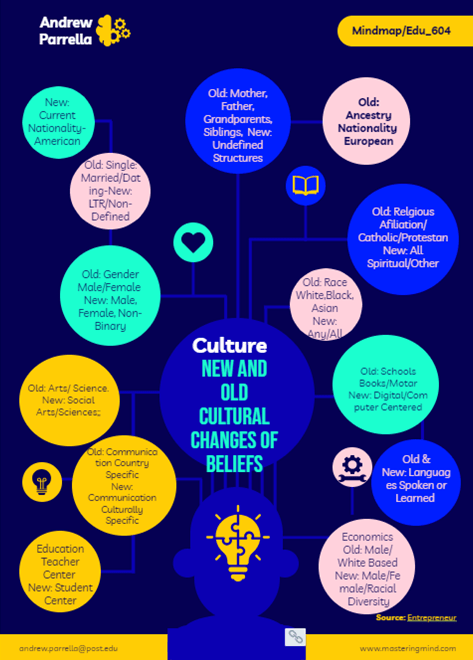
Mindmap Before and After:
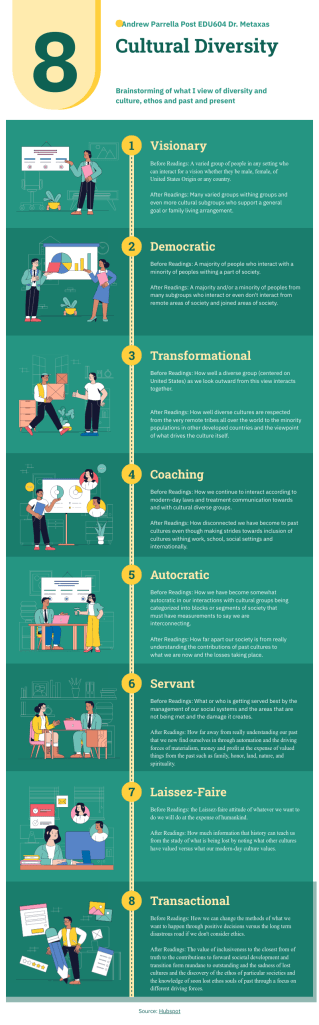
My interpretation of Culture when beginning the class was based on a general eight areas of how we envision or Visionary ide of people such as: people are variable, and their interaction with the world are based on settings, gender, country, and location. This changed to be broader to include subgroups of people and how they view things as well from family, religious, school, economics, race, gender, combination of newly defined genders, and socially constructed ideas of race, ethnicity and sexuality and lifestyles.
The second area is the Democratic or the nature of free interaction between people where they interact with traditionally view minorities with a part of society. After, review and study, I expanded this to include specific references to defined race, ethnicity as interchangeable, and subgroups within main groups from traditional historic basis and learned changes.
The third area was Transformational and the before included more United States views central looking outwardly. After, the diversity and breakdown of looking from other cultures, races, ethnicities, both socially constructed and those that are traditionally defined including gender, sexuality, social class structure, social and educational issues of achievement gaps, institutional racism, multicultural inclusion and exclusionary practices, and immigration and language barriers and children’s gaps and needs, as well as religious and newly defined gender and sexuality issues.
The fourth area from beginning included coaching where we came from an autocratic interacting based with categorized and politically defined segmented societal definitions of that interconnectedness. After, it is still apparent that there are far apart distances in the understanding by people related to myths, fears, past cultural differences, and power that takes place.
The fifth area of interest regarding culture and influences on society and education is who is getting served properly the notion of autocracy mixed with who or what factors are doing or not doing, and the long-term damage created by all this. After, the processes of automation not only technically but in thoughts about defined things like race, ethnicity, gender, religion has been influenced by money, power and traditions like family, honor, resources, nature, and spirituality have change greatly.
The sixth are established is more specific in the who is being Served or not such as what the social systems are brining to the table for these people affected and educational systems. The result of after is we view the past, the transition from automation to the control of money, profit, from values in thinking on traditional values of family, honor, land, education, healthcare which are all interconnected with roles gender, sexuality, religion, and supported systems of people.
Lastly, the Laissez-Faire philosophy and attitude of anyone doing whatever they want to do to benefit the self rather than the group- more of an analogy to teacher centered education vs. student centered education. Incorporating other cultural value systems in these methods is a key point in theorists as well. After would be the overlapping of societal development in this battle of traditional thoughts from family, religions, educational institutions, society, and political driving forces that either change together or clash. The final Mindmap is not just a vertical up and down but branches outward into subsets of the combinations.
References:
Gorski, P. (April 14, 2010). The Challenge of Defining “Multicultural Education. [Web log]
National Association for Multicultural Education. (2018). Definition of multicultural education.
 Education2022