Post University EDU603
Andrew Parrella
Professor Dr. Jennifer Wojcik
Infograph of UDL for Student from Connecticut School System and Learning Plan Design:
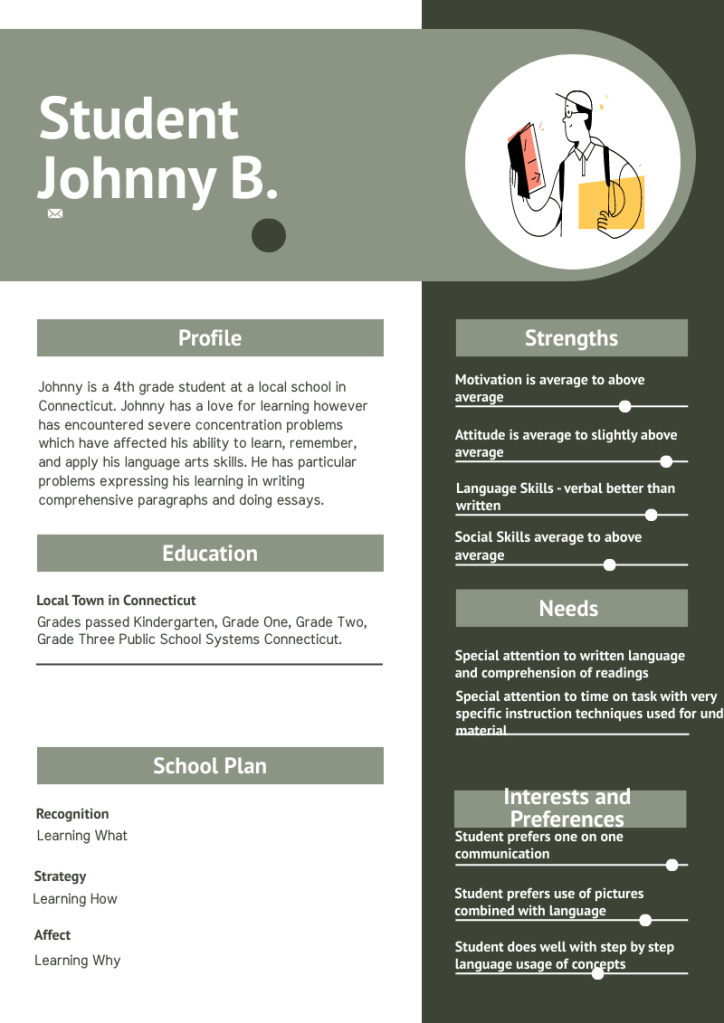
Blog Post For Post University EDU603 by Andrew Parrella
UDL Design and comments Dr. Jennifer Wojcik Professor EDU603
Blog Post on UDL by Andrew Parrella for Post University EDU603 Curriculum Professor Dr. Jennifer Wojcik
The Concept behind the UDL Leaner Profile dates to theorist of many centuries earlier. Starting with Constructivism and the Theoretical Framework of the UbD and UDL for learning, we can note the work of Italian scholar (Giambattista Vico, n.d. as cited in Wojcik, 2016), that in order for students to better understand the world around them there must be a way to build or have meaning by through observations and of those experiences (Wojcik, 2016). Later, John Dewey applied the earlier theories of Vico by “active, hands-on and active approaches towards learning” (Wojcik, 2016).
In order to better understand this process, the infograph above shows three important areas of necessary areas that we must start the design process-
According to Wiggins & McTighe (2006), educators must use filters for the lessons they teach to be able to be of importance so that the teaching and learning is not just context but rather has lasting value. Included in this, is that the curriculum must be in alignment with “core goals of academic discipline,” and be “authentic to the discipline” (Wojcik, 2016).
By doing this, the learner can find meaning that will be constructive to his/her environment and have long-term value. Questioning and “self-awareness” (Wiggins & McTighe, 2013, as cited in Wojcik, 2016), are important to the learning process and by the metacognition of reflection is a key component of this process (Wojcik, 2016).
Formative and summative assessment is also an important part of this process for before and after basis of where one learner is at and where they may be going after the learning. Wojcik (2016)
Learning takes place best through transfer of previous knowledge. Wiggins & McTighe (2005).
“Transfer is the essence of what Bloom and his colleagues meant by application. The challenge is not to “plug in” what was learned, from memory, but modify, adjust, and adapt an (inherently general) idea to the particulars of a situation” (Wiggins & McTighe, 2005).
Recent additions to Constructivism theories include that, “According to this theory, human attributes and abilities are dynamic and malleable” (Wojcik, 2016).
In addition to note is, “How students engage with their peers within educational context is largely grounded in their culture, background, experiences and expectations (Mars, Saether & Folkestad, 2014 as cited in Wojcik, 2016), and requires that educators consider deliberate ways they can meet the needs of learners from a variety of backgrounds within their teaching and learning contexts” (Zhao, Kuh & Carini, 2005 as cited in Wojcik, 2016).
Choice therefore can only compliment an UdB and a UDL and helps for the necessary issue of diversity in the design process. Wojcik (2016) Key to the success of this new model of learning and so often taking centuries to develop, “…the UbD and UDL instructional models are grounded in constructivist educational theory and place the learner at the center of instruction” (Wojcik, 2016).
The Question remains and that is: Will a constructivism/progressivism approach work for our learners going forward in an online UDL environment or will other theories also have to be applied?
References
Wiggins, G. P., & McTighe, J. (2005). Understanding by Design. Alexandria, VA: Assoc. for Supervision and Curriculum Development.
Wojcik, J. (2016). Understanding by design and universal design: Instructional models for a variety of teaching and learning contexts. Post University Blackboard. Retrieved from http://www.post.blackboard.com
Post University EDU603
Andrew Parrella
Professor Dr. Jennifer Wojcik
Development of Unit for UBD and UDL
Stage One of Unit Plan (Part 1)
Stage One of Unit Plan (Part 2)
Overcoming Obstacles and Learning from Different Class Readings
Focusing on Grade 4 Language Arts and Reading Standards Post University Elementary UDL Team
Post University EDU603 Community School
Waterbury, Connecticut
Bad Guys, Who Would win?: Killer Whale vs. Great White Shark, Charlottes’s Web, and I Survived the Titanic, 1912,
AUTHOR’S NOTE:
REMEMBER TO: ““Think big, start small, and go for an early win” (McTighe, 2013).
Welcome to the Fourth Grade Universal Design for Learning
We are here to help and guide you to learn. We want you to ask many questions so that we can have a full range of answers for you. This will stimulate more thinking and solutions for not just understanding what you learn but comprehending what you learn. This will happen when the skills you use that you learn from are practiced and applied.
Good Strategies for teaching – Student Questions – Curiosity, Embracing trial and Error, Intense Reflection. Through reflection and always asking questions we can learn not the surface of a subject, but rather delve deeper into comprehension.
Three rules for lesson planning (Musallam, 2013):
- Curiosity – Ask Questions
- Embrace the mess – Trial and Error
- Practice Reflection – Revision
Academic Standards:
Language Arts
•4.1.1 Read aloud grade-level-appropriate narrative text (stories) and expository text (information) with fluency and accuracy and with appropriate timing, changes in voice, and expression.
• 4.2.1 Use the organization of informational text to strengthen comprehension.
• 4.4.3 Write informational pieces with multiple paragraphs that: provide an introductory paragraph. establish and support a central idea with a topic sentence at or near the beginning of the first paragraph. include supporting paragraphs with simple facts, details, and explanations. present important ideas or events in sequence or in chronological order. provide details and transitions to link paragraphs. conclude with a paragraph that summarizes the points. use correct indention at the beginning of paragraphs.
• 4.4.6 Locate information in reference texts by using organizational features, such as prefaces and appendixes.
• 4.5.3 Write informational reports that: ask a central question about an issue or situation. include facts and details for focus. use more than one source of information, including speakers, books, newspapers, media sources, and online information. (Post University, n.d.)
Planning Pyramid
Some Students will know:
1. The theme of good and bad
2. Why characters have different roles in the different books
3. Who are the good characters and bad characters
4. What are the underlying challenges that face the good characters
5. What are the underlying challenges that bad characters are promoting
6. Where is the location of the story taking place
7. The identity of the characters as humans, animals, fictitious, or real
Most Students will know:
1. The characters and their defined roles in each story
2. Who is the lead character in the story
3. What are the good traits of the good character
4. What are the bad traits of the bad character
5. What obstacle or problem is being focused on
6. Where the location of the story takes place
7. The difference of fictional or realistic characters
All Students will know:
1. The characters and what they represent as roles
2. The identification of who is good and who is bad
3. Identification of a problem that is happening
4. Identification of location of story
5. Identification of similarity to life problem
6. General idea of character as real or not real
7. Identification of building a connection from story to real life
Teacher Library # 1
The Bad Guys:
What Parents Need to Know
Parents need to know that Aaron Blabey’s Bad Guys series about misfit animals on a quest to prove they aren’t as bad as their species’ reputations is a quick, hilarious read, and a fun bunch of graphic novels. The stories don’t offer much in the way of life lessons or modeling how friends should treat each other, but the dialogue between the shark, wolf, snake, and piranha is snappy, full of jokes and insults between friends, and a good amount of potty humor. In other words, young readers will likely enjoy these books, and parents won’t mind reading these aloud, but will likely hope that some of the phrases aren’t repeated (too often) at the dinner table.
Figure One (Blabey, 2016)
Who Would Win
What would happen if a great white shark and a killer whale met each other? What if they had a fight? Who do you think would win?
This nonfiction reader compares and contrasts two ferocious underwater creatures. Kids learn about the killer whale and the great white shark’s anatomies, behaviors, and more. This book is packed with photos, charts, illustrations, and amazing facts.

Figure Two (Pallotta, 2015)
Charlotte’s Web
Figure Three (White, 1952)
The most terrifying events in history are brought vividly to life in this New York Times-bestselling series!
Ten-year-old George Calder can’t believe his luck — he and his little sister, Phoebe, are on the famous Titanic, crossing the ocean with their Aunt Daisy. The ship is full of exciting places to explore, but when George ventures into the first class storage cabin, a terrible boom shakes the entire boat. Suddenly, water is everywhere, and George’s life changes forever.Lauren Tarshis brings history’s most exciting and terrifying events to life in this New York Times-bestselling series. Readers will be transported by stories of amazing kids and how they survived! (Tarshis, 2010).
Figure Four (Tarshis, 2010)
Question for exploration-
How can we continue to have learners use subject material to ask questions that will take them from just knowing an answer to demonstrating a skill that shows comprehension?
Andrew Parrella
Blog reflections on UbD and UDL
It is important that in the process of teaching and curriculum design, that the component of questions that essential are included. Wiggins & McTighe (2005), focus or teaching should be on the larger ideas which can bring and link facts and skills (p. 105). By the UbD having “…framing goals in terms of what we call Essential Questions” (p. 105), a better understanding of task necessary can take place. The aim of essential questions would be to be able to initiate, “full transfer possibilities” (Wiggins & McTighe, 2005) (p.106). Only through the proper creation of the framework of these “thought-provoking questions” (Wiggins & McTighe, 2005) (p.106), can the test of time and sense of transferring of the taught lessons into actual applicable learning be discovered and even measured. A Goal in this unit would be to teach to, “the heart of a particular topic, problem or field of study” (Wiggins & McTighe, 2005) (p. 107).
“Many skills ae successfully mastered only when they become part of a fluent and flexible repertoire, wisely used in performance” (Wiggins & McTighe, 2025) (p.128).
When we discover that skills show mastery through insight and “…meaning is between the lines, not in the lines” (Wiggins & McTighe, 2025) (p.125) we discover that comprehension and the strategies of how we make meaning out of something, must have a “context cue” (Wiggins & McTighe, 2025) (p.125) to be successful.
We must get to the, [so what] of “study” (Wiggins & McTighe, 2025) (p.125) to understand the big picture.
As noted by Dewey (1933) (cited in Wiggins & McTighe, 2005) (p. 131), “..a fact requires apprehension, whereas an understanding requires comprehension.”
References
Blaby, A. (2016). The Bad Guys.
https://www.commonsensemedia.org/book-reviews/the-bad-guys-series
Pallotta, J. (2015). Who Would Win? Killer Whale vs Great White Shark.
https://www.amozon.com/Would-Killer-Whale-Great/dp/0545160758
Tarshis, L. (2010). I survived the Sinking of The Titanic, 1912.
White, E.B., (1952). Charlotte’s Web. https: www.britannica.com/topic/Charlottes-Web
Wiggins, G. P., & McTighe, J. (2005). Understanding by Design. Alexandria, VA: Assoc.
for Supervision and Curriculum Development.
Wiggins G.P., & McTighe, J. (2005). Essential questions: Doorways to understanding.
In J. Houtz (Ed.) Understanding by design (pp. 105-128). Association for Supervision and
Curriculum Development.
Post University EDU603
Andrew Parrella
Professor Dr. Jennifer Wojcik
Part One
Authentic Performance Task using G.R.A.S.P.S.
The goal within this scenario is for students to understand how their government works on the state level through physical attendance at the state capital government buildings in Connecticut.
My role in this task is a teacher and guide for the school classroom in the local town I teach these students in.
The target audience for this lesson is the fourth-grade class age group of 9/10 year olds in a public school setting/town in Connecticut.
The real situation will be the attending of a state legislature joint meeting of all branches of government at the state capital consisting of the Governor, the Senate, and the House of Representative in Hartford Connecticut. The planning of how to get to the capital, the date, times and planned out agenda will be done including the geography of where the capital in Connecticut is located.
The creation or product and purpose of this lesson is to prepare the trip of discovery by working in teams to have a budget for the trip, and the hours necessary to view the legislature at work, and an explanation of what each branch of government’s role is. A picture of the structure of Governors role, Senate roles, and Representatives roles will be created. A map of target destination to get to this location will be obtained and the best trip route from town of origin.
The performance or standard for measurement will be for students must include a plan of time, route, the location of three branches of government offices, the location in Hartford of the capital and why these are the sites that should be visited. A budget can be drawn up for food breaks, and or memorabilia that students may want to purchase for historical reinforcement. By comparing relevant issues that the state of Connecticut is discussing, debating, or statutes the branches of government are enacting that will affect them in their towns/state they reside in, the students will show or demonstrate knowledge. The purpose of this task is to see how the laws they follow in their town are decided upon at the state level government and how this is done.
Task builders and development of G.R.A.S.P.S.
Task builders:
Goal :
• Your task is to guide students on planning a historical trip.
• The goal is to show students how valuable a field trip when planned correctly can give them information about real-world events that affect them.
• The problem/challenge is _____________________________________________________________
• The obstacle(s) to overcome is (are) ____________________________________________________
Role:
• You are the teacher and facilitator
• You have been asked to ______________________________________________________________
• Your job is guide the group in the planning process and eventual learning environment and presence in the new learning place
Audience:
• Your client(s) is (are) 9/10 year old fourth grade level public school students
• The target audience is elementary school learners
• You need to convince _______________________________________________________________
Situation:
• The context you find yourself in is _____________________________________________________
• The challenge involves dealing with ___________________________________________________
Product/Performance and Purpose:
• You will create a plan of expectations for learning for students in order to assist them ni a new learning mode
• You need to develop ________________________________________________________________ so that ___________________________________________________________________________
Standards & Criteria for Success:
• Your performance needs to be measured by their application to their own town and lives
• Your work will be judged by local school system standards and state mastery standards
• Your product must meet the following standards __________________________________________
• A successful result will show that students have transferred knowledge of actual government function and how it relates to them
Example of the GRASPS Model:
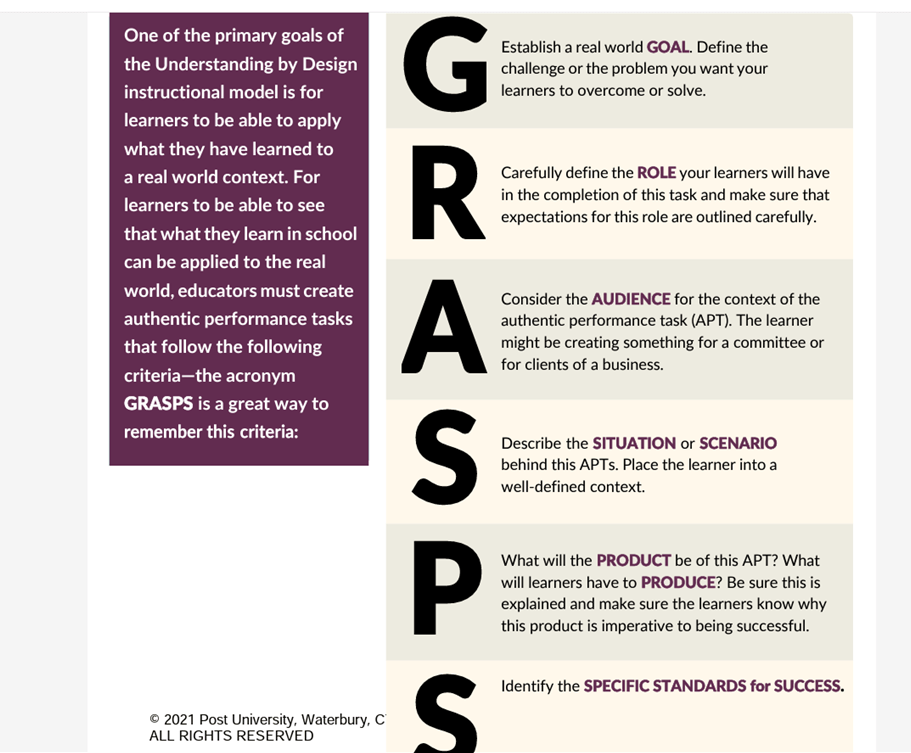
Figure One (Post University, 2021)
Blog Description of Authentic Designs
The differences between authentic assessment and traditional assessment are that in authentic assessment, “the task will call for understanding and transfer, not simply recall or formulaic response” (McTighe, 2016, para. 3. The authentic assessment should show that the task has engaged students so that the knowledge and skills are applied in a “…Depth of Knowledge (DOK) framework developed by Dr. Norman Webb as a reference” (McTighe, 2016, para. 5). Using the G.R.A.S.P.S. design tool we can clearly establish “…an authentic context for performance tasks…” that help the authenticity (McTighe, 2016, para. 7). The Rubric target in the design will help ensure that even after revision, such as self-assessment, peer review and classroom refinement, that we can measure with the association. McTighe (2016). That is the crux of the difference in an authentic assessment and traditional assessment- the inclusion of a very clearly backward designed plan with revision, assessment, refinement, and targeted learning outcomes. The authentic assessment is preferred as it better captures true learning. Listed below are more examples in this design.
“The best designers in education are thus like good architects and savvy contractors, doing two different tasks: (1) as they work, they creatively play with unit ideas, regardless of where those ideas fit on the template, to eventually produce a solid blueprint; and (2) they test the ideas, before and during their use with students, to make it likely that when all is said and done, the goals are accomplished as concrete learning” (Wiggins & McTighe, 2005 p. 255).
Using UbD helps to revise a traditional design by continuously checking against a standard, “that the result is a high-quality design” (Wiggins & McTighe, 2005 p. 255).
Steps include:
- looking for the basic nouns in the standard definition
- Identifying key knowledge and skills call for the content standards
- What are the flowing essential questions from the point to the standard including arguments and inquiries
- Verbs as the blueprints for performance assessment
- Listing of activities for performance enabling and development of understanding big ideas
- Refining of unit and alignment across the three stages.
Design must begin with the application of the real-world related purposes and goals of what we are teaching. If we master a concept, how can we apply it in a real-world setting? The challenges and performance in the setting is key as well as being able to identify what the complex real-world challenges are to get to the goals. Wiggins & McTighe (2005). By further defining through the determination of what needs to be learned or mastered with tasks, a learning plan should have, “…practice, feedback, and competent performance” (Wiggins & McTighe, 2005, p. 255).
Through stages of Desired Results, Assessment of Evidence and Learning Plan we can incorporate what the big ideas are, the underlying ideas or emerging ideas, the skills needed or already present, new, or needed evidence of learning, the real idea to be learned, and the evidence of understanding we want to teach and students to learn. Wiggins & McTighe (2005).
Through the use of experience, essential questions, demonstration of a skill known, assessment of standards with refining for using skills effectively and identification of the content we want to be known, we can then move to the assessment that if clarified properly and according to local or state standards, can show whether the big ideas have been understood through transference.
Part Two
Rubric for Measurement
Standards and Criteria for Success
| Teacher Name: Mr. Parrella Student Name: ________________________________________ |
| CATEGORY | 1 | 2 | 3 | 4 | Scoring Total Points 10 |
| Ideas/Research Questions on Capital Field Trip | Researchers identify, with considerable adult help, 4 reasonable ideas/questions to pursue when doing the research. | Researchers identify, with some adult help, at least 4 reasonable ideas/questions to pursue when doing the research. | Researchers independently identify at least 4 reasonable ideas/questions to pursue when doing the research. | Researchers independently identify at least 4 reasonable, insightful, creative ideas/questions to pursue when doing the research. | /2 |
| Group Timeline on Activity of Visit | Group needs adult help to develop a timeline AND/OR several students in the group cannot independently describe the high points of the timeline. | Group independently develops a timeline describing when most parts of the work will be done. Most students can independently describe the high points of the timeline. | Group independently develops a timeline describing when most parts of the work will be done. All students in group can independently describe the high points of the timeline. | Group independently develops a reasonable, complete timeline describing when different parts of the work (e.g.,planning, research, first draft, final draft) will be done. All students in group can independently describe the high points of the timeline. | /2 |
| Delegation of Responsibility of Student | One or more students in the group cannot clearly explain what information they are responsible for locating. | Each student in the group can, with minimal prompting from peers, clearly explain what information s/he is responsible for locating. | Each student in the group can clearly explain what information s/he is responsible for locating. | Each student in the group can clearly explain what information is needed by the group, what information s/he is responsible for locating, and when the information is needed. | /2 |
| Plan for Organizing Information for Big Idea Understanding | Students have no clear plan for organizing the information AND/OR students in the group cannot explain their organizational plan. | Students have developed a clear plan for organizing the information as it is gathered. All students can independently explain most of this plan. | Students have developed a clear plan for organizing the information in the final research product. All students can independently explain this plan. | Students have developed a clear plan for organizing the information as it is gathered and in the final research product. All students can independently explain the planned organization of the research findings. | /2 |
| Quality of Sources Gathered to Assess Transference of Knowledge | Researchers, with extensive adult help, locate at least 2 reliable information sources for EACH of their ideas or questions. | Researchers, with some adult help, locate at least 2 reliable information sources for EACH of their ideas or questions. | Researchers independently locate at least 2 reliable information sources for EACH of their ideas or questions. | Researchers independently locate at least 2 reliable, interesting information sources for EACH of their ideas or questions. | /2 |
Reflection on Authentic Performance task created is related to the Stage One Assessment Design by asking for specific and active engagement of the learners building on their previously learned knowledge that they have up to this point and applying this new knowledge of field trip organization, individual ideas, group ideas and specific planning necessary to find the way to the new learning source (live Government in Action) and then using real-life knowledge and demonstrating through critical thinking of ways that knowledge affects their daily living.
This task should prove meaningful for learners in this age group as they will be able to cognitively associate and show verbally, through written essay, media online comparison data, and creative description in art, science or mathematical expression a broader and deeper understanding of why and how the government decisions affect or influence life situations.
Engaging Question:
To stretch the readers imagination further- What would happen if we had our elementary students try to run our government at either the town or state level for one day in the various roles they have observed and would this give insight to both the adults who presently are running the government and give even more insight as to the “why” does this decision happen to the new learners?
References
Wiggins, G. P., & McTighe, J. (2005). Understanding by Design. Alexandria, VA: Assoc. for Supervision and Curriculum Development.
McTighe, J. (2016). How Can Educators Design Authentic Performance Tasks? (Part 3). Learning Personalized. https://www.learningpersonalized.com/authentic-performance-tasks/
Appendix
Post University. EDU630 Curriculum 2.0 (2021). http://www.postuniversity.com/blackboard
Andrew Parrella
Post University EDU603 Unit 7 Blog Assignment 4
Professor Dr. Jennifer Wojcik
Part One (Stage Three)
Learning Plan for Implementation of application of WHERETO in the UDL PLE plan for students at the Elementary Grade 4 Level for Public School System in Waterbury Connecticut – Online Module
W: WHERE the Unit is headed and WHAT is expected of learners.
This Unit is now fully in development as it will now be enhanced through introduction of Web 2.0 technology to enhance learners through those type of tools. The learners will be expected to start using Web 2.0 technology that will help in their discovery of more knowledge to continue to build on their knowledge of previously introduced goals: Motivation, overcoming challenges to learning and can apply the new tools of web technology to enhance their knowledge. A Rubric in the beginning will be presented. Goal explanation and pre-testing of the Unit will help focus.
H: How to HOOK each student and HOLD their interest throughout the learning plan.
The hook for each student will be to pick an interesting piece of the “pie” that they have been introduced to so far in the challenge of how the players in the readings overcame their problems and in the second stage how the government leaders solved problems for the Connecticut residents. As in former assigned literature readings, the field trip to the capital historical and governmental issues they planned out, the students must uncover the problem that must be or was overcome and how. They, then will use a Web 2.0 software such as: Edublogs- Blooger, WordPress, Kidblogs, Weebly, Campuspress, and may add others such as: Padlet, Prezi, and Googledocs to enhance their verbal and especially written language skills.
E: The ways you to EQUIP students to help them EXPERIENCE and EXPLORE
By having these website links available on the PLE or a part of the PLE page dedicated to the Web 2.0 additional aides, the students can be equipped to have the greater experience of exploration that they will do in their internet searches and use of at least one but many technologies can be chosen to express themselves as to what, how, the problems were solved by demonstrating each case specifically. The key or challenge to fully experience the learning will be for the students to keep exploring the overcoming of the obstacle and even when finding one solution they should be challenged to find another solution which would help the different learners as well as the first solution may not be readily accessible or easily discerned by the LD learner but a different type of technology could bridge that gap ie: hearing impaired technology, speech issues, association concept issues, etcl, The learning that the students will be challenged about could end up showing the students an entirely different solution then as what was previously obvious or uncovered. The two former stages therefore and choice of decision of Web 2.0 should help with those students through meeting differentiation.
R: Opportunities for formative assessment. Being able to RETHINK, REVISIT or REVISE work in order to grow and improve?
The students must rethink, revisit and revise their verbal showcased presentations or visual presentations and written presentations through many opportunities. By having other students involved in the learning, the one-on-one and/or group feedback can enhance the perfecting of the demonstration of their learning by helping to transfere that learning by thinking differently in comparison and critique.
E (2): Students to EVALUATE or self-assess their own work.
Evaluating for the students will be done by other students, one-on-one partners, group thoughts and suggestions, and teacher (mentor) to student (learner) mode. Through specific rubrics, checklists, journals, and teacher-let conferences to help with revisions. The creation of these should be lead by the teacher however in some cases, the students will “check each other” and the several evaluations are meant to provide a safe, positive environment that is not punitive but rather expands on concepts with meeting local and state mandated standards of measurement.
T: Learning plan is TAILORED – the learning plan meets the variability of learners. Using multiple modalities and using technology- (the creative use of technology will be incorporated in plan)
Tailoring this learning plan will be a constant editing and revision process over a time period after seeing what is working for the particular group under instruction for that yearly time period. Best approach would be at least quarterly, monthly, and weekly. Through listed Web 2.0 technologies such as listed above: Edublogs- Blooger, WordPress, Kidblogs, Weebly, Campuspress, and others such as: Padlet, Prezi, and Googledocs, the geared learning plan would be as flexible as needed in each case of differentiated need. In this Unit, mostly language, critical concept thinking and application of demonstration of the skills of comparison using different forms of learning environments, readings (books), live action (government in process) and introduction of internet tools such as Web 2.0 products and software, this Unit can really thrive, drive and survive the learning for students!
O: Students to stay ORGANIZED so they can be effective learners.
Organization is key to the completion of a successful unit or any learning formatted in a UbD and PLE as if students can navigate from one area to another in the unit, they will be able to establish a streamlined approach to the learning. Therefore, KEY WORDS with the ability to check facts such as a quick FACTS CHECK button the students can click on will make the students be able to quickly refer back to basic questions about the material presented:
Stage One: Books presented and links to overviews, writing tips, thesaurus hints, sentence structure tips, and paragraph structure tips are some ways to start for fact checking.
Stage Two: Government Internet Information links at local, state, and federal level for reference help and Terminology Tips for names of Government breakdown such as Representatives, Senate, Governor’s roles.
All Stages: Outlined formatted Plans with Titles and then either Roman Numerals or more informal Letter and Numbering systems keep organization at a viewing point of understanding.
All Stages: Pictures, videos, and media interaction can keep interested througout.
EXAMPLE of WHERETO MODEL
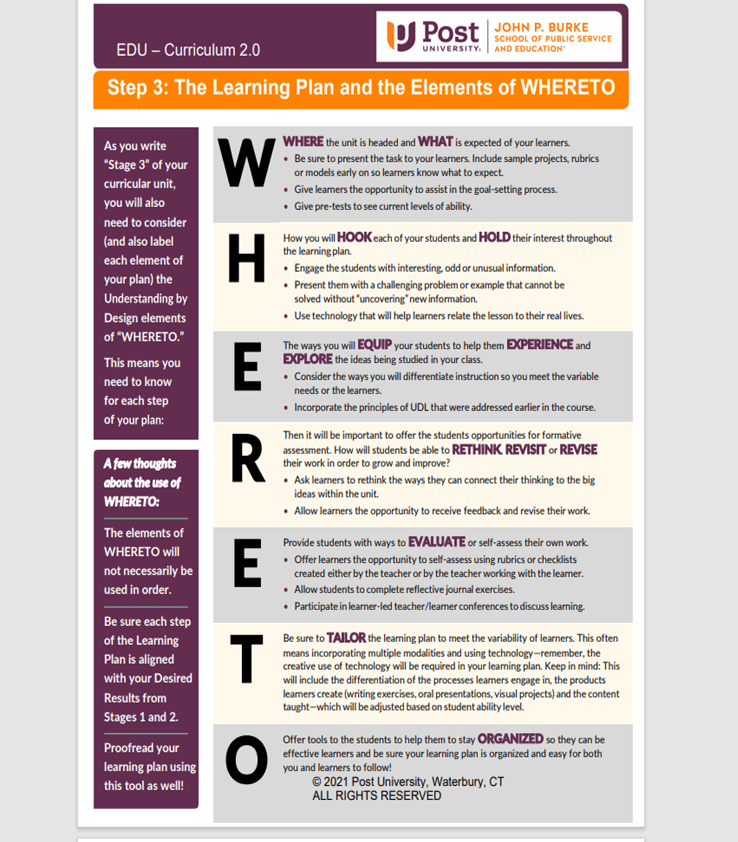
Figure One (Post University, 2021)
Blog Reflections
In stage one of our learning plan, we must be able to help students learn by being able to make their learning environment one that is tailored to their specific needs as much as possible.
As stated earlier in the learning process, essential questions must be included for students to have the best curriculum design, that the component of questions that essential are included. Wiggins & McTighe (2005), focus or teaching should be on the larger ideas which can bring and link facts and skills (p. 105). By the UbD having “…framing goals in terms of what we call Essential Questions” (p. 105), a better understanding of task necessary can take place. The aim of essential questions would be to be able to initiate, “full transfer possibilities” (Wiggins & McTighe, 2005) (p.106). Only through the proper creation of the framework of these “thought-provoking questions” (Wiggins & McTighe, 2005) (p.106), can the test of time and sense of transferring of the taught lessons into actual applicable learning be discovered and even measured. A Goal in this unit would be to teach to, “the heart of a particular topic, problem or field of study” (Wiggins & McTighe, 2005) (p. 107).
There are three main principals of the UDL which help us to follow the use of technology and these guidelines provide a framework for identifying specific evidence-based options and alternatives to consider in designing successful learning activities for all students. The three types of multiple representations are: “Provide Multiple Means of Action and Expression and Provide Multiple Means of Engagement (Rose, Gravel, & Domings, para.1, 2012). By doing this, “the newer technologies allow, and encourage, flexibility and diversity instead. This power and flexibility greatly enhance the ability to individualize and customize the learning experience.
Does technology make it easier to address the equal access for students that need to have an environment that enables better exposure? As noted, “UDL is a framework that can decrease barriers and maximize learning opportunities for all learners—from early childhood to adulthood…. Preschools to institutes of higher education have begun embracing UDL in order to improve learning opportunities for all students (Rose, Gravel, & Domings, para. 5, 2012).
In stage two of the learning plan we can help further in the devlopment of a good planned design if we apply the WHERETO concept of learning.
By applying the concepts of WHERETO, these technologies can tell us where the unit we are teaching is headed, what the learners can expect, the learner can be hooked and they will hold the attention of the learner, students will become equipped, explore more of the technology due to its features, and experience a lot of knowledge through visual, audio technology that can also help then rethink, revisit, and/or revise their testing for deeper learning.
Evaluating of the self-learning or assisted learning can be tailored and organized in any way so that the UDL is designed using a specific technology or one or combination to express the best teaching for learning and include differentiation to specific learner’s needs ie: hearing impaired, LD learners, visual needs, ADD and many others.
In stage three of the learning plan we implement WHERETO and the larger or big ideas behind the learning we ask many questions that are essential and stimulate knowledge, skills and understandings of the following.
Reflection on Learning Plan and the relationship of the questions of how and why this plan will be meaningful for my learners-
The specific learners in the context of an elementary school setting are unique in that each comes from a unique socio-economic culture, previously learned grade level either in the same school structure or perhaps from a geographical area far away. Many learners may have LD challenges which would require applying the concepts of GRASPS and WHERETO in the plan.
Learning takes place best through transfer of previous knowledge. Wiggins & McTighe (2005).
In addition to we must by able to According to as educators be able to tailor the learning accordingly. Wiggins & McTighe (2006), educators must use filters for the lessons they teach to be able to be of importance so that the teaching and learning is not just context but rather has lasting value. Included in this, is that the curriculum must be in alignment with “core goals of academic discipline,” and be “authentic to the discipline” (Wojcik, 2016).
Lastly, choice therefore can only compliment an UdB and a UDL and helps for the necessary issue of diversity in the design process. Wojcik (2016) Key to the success of this new model of learning and so often taking centuries to develop, “…the UbD and UDL instructional models are grounded in constructivist educational theory and place the learner at the center of instruction” (Wojcik, 2016).
This says it all and is a constantly changing structure of development and the UbD, UDL and the PLE are ways to accomplish this.
ENGAGING QUESTION:
The last engaging question asked the following:
To stretch the readers imagination further- What would happen if we had our elementary students try to run our government at either the town or state level for one day in the various roles they have observed and would this give insight to both the adults who presently are running the government and give even more insight as to the “why” does this decision happen to the new learners?
Expansion of the former engaging question would be – What would happen if we had a national emergency where the roles not only changed for traditional teacher/learner capacity we were engaged in, but learners were made to have a “mock-reality” living situation for “one-week” – testing their ability to use all they know, learned in school, and real life to make major descisions. We are dealing in this learner framework of 9/10 year-olds during an impressionable time in their development therefore, we could actually observe this a “pre-testing” mode for evaluation of a child’s maturity level and hence – how does this child overcome obstacles or get past challenging situations in life.
Therefore, to expand on the engaging question would be to again ask- what are we measuring or missing in measurement from a child’s behavior and tracked individualized learning “scenario” not just in the school setting but real life setting that is influencing the ability of instructional design to tailor a plan that is effective for differentiation?
A small memory from my past on a basic level in the school setting is this:
I remember this often happened when we had a substitute and the students started to run the music class – as that substitute (Mrs. Reed) simply said to the students: “Do whatever you want to do today related to music, work in groups, practice on your own and help each other.” She of course qualified this with, “But, stay out of trouble!” The music class was an absolute blast that day!
Andrew Parrella
References
Post University, (2021). Step 3: The Learning Plan and Elements of WHERETO. EDU Curriculum 2.0. http://www.postuniversity.com/blackboard/edu603/unit7/notes/
Rose, D. H., Gravel, J. W., & Domings, Y. M. (2012). UDL Unplugged: The Role of Technology in UDL. In T. E. Hall, A. Meyer, & D. H. Rose (Authors), Universal design for learning in the classroom: Practical applications (pp. 120-134). New York, NY: Guilford Press.
Wiggins, G. P., & McTighe, J. (2005). Understanding by Design. Alexandria, VA: Assoc. for Supervision and Curriculum Development.
Wojcik, J. (2016). Understanding by design and universal design: Instructional models for a variety of teaching and learning contexts. Post University Blackboard. Retrieved from http://www.post.blackboard.com
Appendix
Post University (2021). The Learning Plan and Elements of WHERETO. EDU-Post University Curriculum 2.0. https://www.post.blackboard.com/edu603/Step3/
Part Two – Self Assessment Rubric for success of unit creation:
Rubric for Self-Evaluation of Program Success
Teacher Name: Mr. Andrew Parrella
Student: Variable
Final Reflection on Curriculum Project
I found this Unit on EDU603_30_Curriculum_2.0_2022_2023 Terms Unit 8 Final Project very useful and have learned an immense amount of information which can be applied to create, develop, and enable a curriculum that can use the principals of UbD and UDL in the PLE to enhance learning for all ages of learners. This can benefit all learners but especially those needing differentiation that can be tailored to each individual’s needs. This is an excellent learning module.
 Education2022